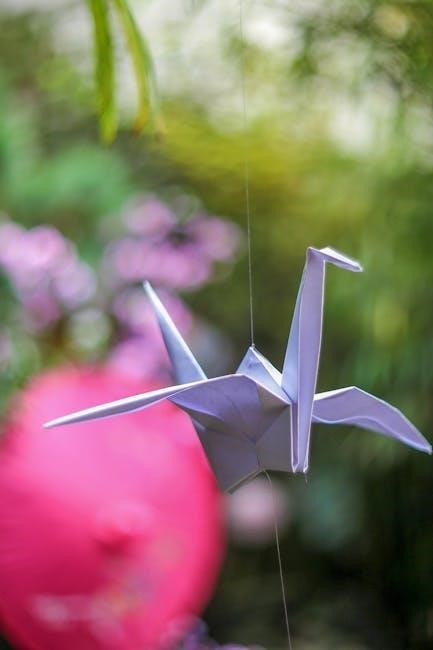
Complex origami transcends traditional folding, featuring intricate designs like realistic insects by Robert Lang, often requiring specialized papers and wet-folding techniques.
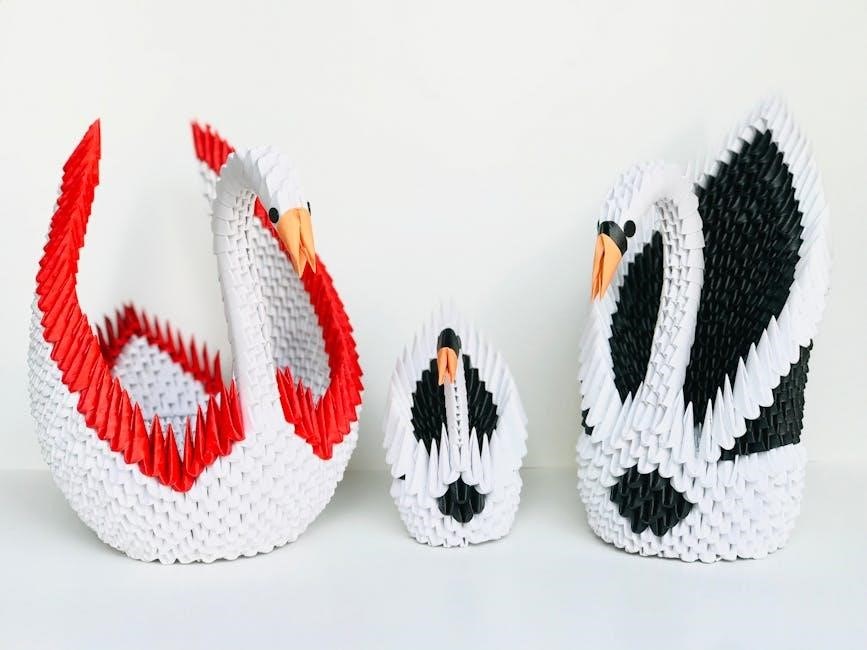
It showcases advanced artistry, moving beyond simple shapes into geometric sculptures and modular constructions built from repeating units.
What Defines “Complex” Origami?
Complex origami isn’t simply about the number of steps, but the intricacy of those steps and the resulting form. It often involves a high degree of precision, demanding patience and skill from the folder. Models frequently move beyond single-sheet designs, utilizing modular origami – assembling multiple identical units to create larger, more elaborate structures.
Realistic depictions, like Robert Lang’s insects, exemplify complexity, requiring wet-folding to achieve curved, organic shapes. Furthermore, designs incorporating advanced techniques like reverse folds and sink folds contribute to the overall difficulty. The use of crease patterns (CP) also signifies a complex undertaking, demanding interpretation and accurate execution.
Historical Overview of Advanced Origami Techniques
While traditional origami focused on representational forms, the pursuit of complexity began gaining momentum in the 20th century. Akira Yoshizawa’s innovations, including the wet-folding technique, were pivotal, allowing for softer, more sculpted models. Later, the work of Robert Lang revolutionized the field, introducing mathematical principles – like tree theory – to origami design.
Modular origami, with roots in ancient traditions, experienced a resurgence, enabling the creation of incredibly intricate geometric structures. The development of crease patterns (CP) provided a new language for designers, facilitating the creation of increasingly complex and detailed models, pushing the boundaries of paper folding.
Essential Materials for Complex Origami
Complex origami demands specialized tools: Washi and Tant papers offer strength and texture, while bone folders and tweezers aid precise folding and shaping.
Specialty Papers: Washi, Tant, and More
Complex origami frequently necessitates moving beyond standard paper choices. Washi, a traditional Japanese paper, provides exceptional strength and a beautiful texture, crucial for intricate models. Tant paper, known for its vibrant colors and durability, is another popular selection among advanced folders.
These papers hold creases remarkably well, resisting tearing during complex manipulations. Beyond these, consider Lokta paper for its fibrous quality or even elephant hide paper for extreme durability. The paper’s weight and fiber direction significantly impact the final form, demanding careful consideration when tackling challenging designs. Selecting the right paper is paramount for successful, lasting creations.
Tools Beyond Basic Folding: Bone Folders, Tweezers, etc.
Complex origami often demands tools extending beyond simple hand-folding. A bone folder is essential for creating sharp, precise creases, vital for intricate designs. Tweezers become indispensable for manipulating small flaps and points, especially in detailed models like Robert Lang’s insects.
Other helpful tools include a paper crimper for textured effects, a needle tool for precise shaping, and even a spray bottle for wet-folding. Practicing with larger paper and simpler models first builds dexterity. Don’t underestimate the value of a cutting mat and a ruler for accurate preparation!
Fundamental Techniques for Advanced Models
Advanced origami relies on techniques like wet-folding for shaping, mastering reverse folds for detail, and utilizing sink folds to build internal structure and complexity.
Wet-Folding: Shaping with Moisture
Wet-folding is a pivotal technique in complex origami, enabling artists to create organic curves and realistic forms unattainable with dry-folding alone. This method involves lightly dampening the origami paper – typically Washi or Tant – allowing it to become malleable and hold sculpted shapes.
The moisture softens the fibers, facilitating gentle manipulation and precise adjustments. It’s crucial to avoid over-saturation, as this can weaken the paper. Robert Lang frequently employs wet-folding in his renowned insect designs, achieving remarkable detail and lifelike contours. Mastering this technique unlocks a new dimension of artistic expression within the world of origami.
Reverse Folds and Their Variations
Reverse folds are fundamental maneuvers in complex origami, forming the backbone of intricate designs. These folds involve inverting a flap of paper, creating hidden layers and shaping internal structures. Variations include the inside reverse fold, where the flap is tucked within the model, and the outside reverse fold, exposing the inverted section.
Mastering these techniques is essential for interpreting origami diagrams and executing complex crease patterns. They allow for precise control over form and enable the creation of detailed features. Complex geometric origami, like the Great Stellated Dodecahedron, heavily relies on precise reverse folds for structural integrity.
Sink Folds: Creating Internal Structure
Sink folds are pivotal in complex origami, enabling the creation of internal pockets and shaping three-dimensional forms. Unlike external folds, sink folds push a section of paper inside the model, collapsing layers to define volume and detail. They are crucial for achieving realistic curves and intricate features, particularly in designs like Robert Lang’s insect models.
Successfully executing sink folds demands precision and understanding of paper behavior. They often accompany reverse folds, working in tandem to build complex structures. Learning to read crease patterns (CP) is vital for identifying where sink folds are required, unlocking the potential for advanced designs.
Exploring the Work of Robert Lang
Robert Lang’s origami designs, especially his incredibly detailed insects, exemplify complexity, often utilizing wet-folding and his innovative Tree Theory for design.
Lang’s Insect Designs: A Showcase of Complexity
Robert Lang is renowned for his breathtakingly realistic and complex insect origami models. These aren’t simple folds; they represent a pinnacle of the art form, demanding significant skill and patience from folders.
His creations, like cicadas, dragonflies, and beetles, showcase an astonishing level of detail, achieved through meticulous planning and advanced techniques like wet-folding. This process allows for shaping and refining the paper to mimic the organic forms of insects.
Lang’s designs often require specialty papers to withstand the manipulation and maintain the intricate details. They serve as a powerful demonstration of how far origami can be pushed, blurring the line between art and engineering.
The Tree Theory and Design Principles
Robert Lang’s “Tree Theory” revolutionized origami design. It provides a systematic approach to folding complex models, breaking down the desired shape into a branching “tree” structure of creases.
This method allows designers to pre-plan the entire folding sequence, ensuring that all necessary creases can be accommodated within a single sheet of paper. Key principles include understanding how creases interact and utilizing techniques like box pleating and circle packing.
The theory emphasizes mathematical precision and geometric understanding, transforming origami from an intuitive art into a more predictable and controllable design process.

Modular Origami: Building with Units
Modular origami involves assembling complex forms from identical, pre-folded units or modules – like Sonobe or waterbomb bases – creating larger, intricate structures.
This technique allows for the creation of impressive shapes through repetition and interconnectedness.
Types of Modular Origami: Sonobe, Waterbomb, etc.
Modular origami encompasses diverse unit types, each offering unique construction possibilities. The Sonobe module, renowned for its interlocking capability, forms robust polyhedra with relative ease, making it popular for beginners venturing into modularity.
Conversely, the waterbomb base, a classic origami foundation, lends itself to more organic and flowing modular designs. Other notable types include the Miura-ori fold, known for its compact, expandable structure, and various polygonal modules.
These units, when combined strategically, yield complex geometric forms and artistic creations, demonstrating the versatility of modular origami.
Creating Complex Shapes from Simple Modules
The beauty of modular origami lies in assembling intricate structures from identical, or sometimes varied, simple units. A seemingly basic module, repeated and connected, can blossom into astonishingly complex forms – from geodesic domes and stellated polyhedra to abstract sculptures.
The key is understanding how modules interlock and the geometric principles governing their arrangement. Careful planning and precise folding are crucial for achieving structural integrity and aesthetic appeal.
This approach allows for the creation of large-scale origami without requiring a single, enormous sheet of paper, expanding design possibilities.
Complex Geometric Origami
Geometric origami explores mathematical forms, like the challenging Great Stellated Dodecahedron, and tessellations – repeating patterns created through precise folding and design.
These models demand accuracy and a strong grasp of spatial reasoning.
Polyhedral Origami: The Great Stellated Dodecahedron
The Great Stellated Dodecahedron represents a pinnacle of origami complexity, requiring the folding of sixty triangular units from twenty individual sheets of paper. This challenging model showcases the intersection of geometry and artistry, demanding exceptional precision and patience from the folder.
Constructing this polyhedron isn’t for beginners; it’s a project for those with significant origami experience. Successfully completing it demonstrates mastery of complex folding techniques and a deep understanding of three-dimensional spatial relationships. It’s a visually stunning piece, embodying the potential of origami to create intricate and mathematically fascinating sculptures.
Tessellations: Repeating Patterns in Origami
Origami tessellations involve creating repeating patterns across a flat sheet of paper through intricate folding. Unlike traditional models focusing on a single form, tessellations emphasize the interplay of creases to generate a visually captivating, tiled surface; This advanced technique requires careful planning and precise execution to ensure seamless repetition.
Mastering tessellations demands a strong grasp of geometric principles and crease patterns. While seemingly complex, the beauty lies in building a larger design from smaller, repeating units. It’s a rewarding challenge for experienced folders seeking to explore the artistic possibilities of patterned origami.
Resources for Learning Complex Origami
Online tutorials like Paper Kawaii and numerous books offer step-by-step guides for advanced origami, aiding progression from intermediate models with patience and precision.
Online Tutorials and Websites (Paper Kawaii, etc.)
Numerous online platforms provide invaluable resources for aspiring complex origami artists. Paper Kawaii stands out, offering a comprehensive library of advanced tutorials, guiding enthusiasts through intricate folds with clear, step-by-step instructions.
YouTube is also a treasure trove, hosting channels dedicated to origami, showcasing diverse models and techniques. Websites dedicated to origami often feature diagrams and crease patterns (CPs), essential for tackling challenging designs.
These digital resources democratize access to complex origami, allowing learners to progress at their own pace, explore various styles, and connect with a global community of folders. Practice with these resources is key!
Books and Publications on Advanced Origami
While online resources abound, traditional books and publications remain cornerstones for serious complex origami learners. These often present meticulously detailed diagrams and explanations, surpassing the clarity of some digital formats.
Publications dedicated to the work of masters like Robert Lang offer insights into his design principles and techniques. Books focusing on specific areas, such as modular origami or tessellations, provide in-depth knowledge.
Furthermore, exploring publications helps build a foundational understanding of origami history and theory, complementing practical folding skills. Order some Kraft paper and begin!
Decoding Origami Diagrams
Understanding crease patterns (CP) and complex diagram symbols is crucial for tackling advanced models. These visual guides unlock the sequence of folds needed for intricate designs.
Understanding Crease Patterns (CP)
Crease patterns (CP) represent a flattened, unfolded origami model, displaying all the creases as lines on the paper. Mastering CP reading is essential for tackling complex origami, allowing folders to visualize the entire structure before making a single fold.
Unlike traditional step-by-step diagrams, CPs offer a holistic view, demanding spatial reasoning and an understanding of how folds interact. Learning to interpret these patterns unlocks the ability to fold from designs without explicit instructions, fostering creativity and design skills.
Initially, CPs can seem daunting, but practice with simpler models builds familiarity. Recognizing valley and mountain folds, understanding symmetry, and identifying key reference points are vital steps in decoding these intricate maps to origami mastery.
Reading Complex Diagram Symbols
Complex origami diagrams utilize a specialized symbolic language beyond basic arrows. Understanding these symbols is crucial for accurate folding. Symbols indicate reverse folds, squash folds, petal folds, and sink folds – maneuvers essential for creating intricate shapes.
Diagrams often employ dotted and dashed lines to represent hidden creases or folds occurring behind existing layers. Arrows with different thicknesses or styles denote varying degrees of folding or the direction of paper movement.
Familiarizing yourself with this visual vocabulary unlocks the ability to decipher even the most challenging designs, enabling you to translate abstract symbols into precise, three-dimensional forms. Patience and careful observation are key to mastering this skill.
Practice and Progression
Consistent practice, starting with intermediate models, is vital. Patience and precision are paramount; begin with tutorials, then books, and finally, crease patterns (CP).
Starting with Intermediate Models
Embarking on complex origami demands a gradual approach. Don’t immediately attempt the most challenging designs; instead, build a solid foundation with intermediate models. These offer a stepping stone, introducing advanced techniques without overwhelming frustration.
Fancy boxes, stars, and intricate flowers are excellent starting points, providing valuable practice in precision folding and understanding complex sequences. Focus on mastering fundamental folds like reverse folds and sink folds before tackling more elaborate structures.
Utilize readily available resources like Paper Kawaii’s advanced tutorials to guide your initial explorations. Remember, consistent practice is key to developing the dexterity and spatial reasoning required for success in complex origami.
The Importance of Patience and Precision
Complex origami is not a pursuit for the impatient. Success hinges on meticulous precision and unwavering patience. Each fold must be accurate, as even minor errors accumulate and disrupt the final form. Rushing through steps inevitably leads to frustration and potentially irreparable mistakes.
Practice consistently, and don’t be discouraged by initial setbacks. Order bulk Kraft paper for dedicated practice, honing your skills through repetition. Take your time, carefully following diagrams and tutorials.
Remember, the beauty of origami lies not only in the finished product but also in the meditative process of creation. Embrace the challenge and enjoy the journey!
Troubleshooting Common Issues
Paper tears and miscreations are common in complex origami. Carefully undo folds, and reinforce weak areas. Patience and precision are key to correction!
Dealing with Paper Tears and Creases
Paper tears are almost inevitable when tackling complex origami models, especially with intricate designs. Small tears can sometimes be carefully concealed within folds, or reinforced with a tiny amount of glue – use sparingly! For creases that aren’t intended, gently try to reverse the fold, but be mindful not to weaken the paper further.
Preventative measures are also crucial; using high-quality paper designed for origami, like Washi or Tant, significantly reduces tearing. Wet-folding can also make the paper more pliable, lessening the chance of accidental damage. Remember, patience is paramount; rushing increases the risk of errors and tears.
Correcting Mistakes in Complex Folds
Correcting errors in complex origami requires a delicate touch. Often, carefully unfolding a section – slowly and gently – can allow you to backtrack to the point of the mistake. However, repeated unfolding weakens the paper, increasing the risk of tears. If a fold is deeply ingrained, accept that a perfect correction might not be possible.
Practice on simpler models first to build your understanding of fold sequences. Don’t be afraid to start over if the mistake is significant; sometimes, it’s more efficient than attempting a complex repair. Patience and precision are key to minimizing errors in the first place!
Advanced Design Considerations
Box pleating and circle packing are crucial for complex origami design, enabling intricate structures and efficient paper usage for challenging models.
Box Pleating and its Applications
Box pleating is a fundamental technique in advanced origami, involving pre-creasing a grid of mountain and valley folds across the paper. This creates a structured base allowing for complex shaping and detailed forms. It’s particularly useful for designs requiring precise angles and symmetrical features, like geometric sculptures or realistic animal models.
Essentially, it transforms a flat sheet into a malleable surface, enabling designers to sculpt three-dimensional shapes with greater control. Mastering box pleating unlocks the potential for intricate designs, offering a pathway to creating highly detailed and structurally sound origami creations. It’s a cornerstone of many complex models.
Circle Packing and its Role in Design
Circle packing is a sophisticated design principle utilized in complex origami, focusing on efficiently arranging circles within a given space. This mathematical concept translates into optimal paper usage and structural integrity in origami models. By strategically positioning creases based on circle packing principles, designers can maximize the complexity and detail achievable within a folded form.
It allows for the creation of intricate patterns and organic shapes, often seen in tessellations and realistic representations. Effectively, circle packing provides a framework for minimizing waste and enhancing the aesthetic appeal of advanced origami designs, pushing the boundaries of what’s possible.
The Future of Complex Origami
Computational origami and innovative tools are emerging, alongside new artists, revolutionizing design. These advancements promise even more intricate and breathtaking origami creations.
Computational Origami and New Design Tools
Computational origami represents a fascinating intersection of mathematics, computer science, and the ancient art of paper folding. Software now assists designers in creating incredibly complex crease patterns (CPs) that would be nearly impossible to devise manually.
These tools allow for the simulation of folds, prediction of paper behavior, and optimization of designs for structural integrity and aesthetic appeal. This opens doors to exploring previously unimaginable geometric possibilities.
Furthermore, algorithms are being developed to automatically generate origami designs from 3D models, streamlining the design process and enabling wider accessibility to complex origami creation.
Emerging Artists and Innovative Techniques
A new wave of origami artists is pushing the boundaries of the art form, experimenting with unconventional materials and techniques beyond traditional paper. These innovators are exploring the use of curved folds, tessellations with intricate repeating patterns, and combining origami with other art forms like sculpture and digital fabrication.
They are also sharing their knowledge through online tutorials, like those found on Paper Kawaii, fostering a vibrant community and accelerating the evolution of complex origami.
This collaborative spirit is driving the development of increasingly sophisticated designs and techniques.
Organizational Charts and Origami (Unexpected Connection)
Origami’s principles of folding and unfolding to reveal structure mirror visualizing complex systems, like organizations; Organimi utilizes this for clear representation.
Using Origami Principles for Visualizing Complexity
Origami’s inherent nature of transforming a flat sheet into a complex three-dimensional form offers a compelling analogy for understanding and representing intricate systems. Just as a complex origami model emerges from a series of precise folds, complex organizational structures arise from interconnected relationships and hierarchical layers.
The process of unfolding an origami creation to reveal its underlying structure parallels the need to deconstruct complex systems to understand their components and interdependencies. This visual metaphor can be powerfully applied to organizational charts, allowing for a more intuitive grasp of reporting lines, departmental structures, and overall organizational complexity; The precision required in origami mirrors the need for accurate data and clear definitions within an organizational framework.
Organimi as a Tool for Complex System Representation
Organimi excels at translating intricate organizational structures into visually accessible charts, mirroring the clarity achieved through well-executed origami. Its drag-and-drop interface and import capabilities from CSV or Excel files streamline the process of building complex representations, eliminating the need for manual drawing or cumbersome spreadsheets.
Like unfolding an origami model to reveal its underlying pattern, Organimi allows users to explore hierarchical relationships and departmental connections with ease. The software’s cloud-based nature facilitates collaboration and ensures charts remain current, reflecting the dynamic nature of organizations. It’s a powerful tool for visualizing complexity and fostering understanding.